This just in: I am abandoning my wordpress blog www.liveyoursubjectivity.worpress.com.
mercredi 21 novembre 2012
NEWS NEWS NEWS!

mardi 20 novembre 2012
Stephen Harpie: The Other Great Darkness?
For the November 15th class.
We saw in class Paul Emile Borduas' Refus Global (1948), a text that would foreshadow Quebec's quiet revolution.

At this time, the Maurice Duplessis governement has been in political power for eight years, and yet more was yet to come (with Duplessis in power from 1936 to 1939 and from 1944 to 1959). This time is often referred to as the Great Darkness because of the government's strict adherence with the church (especially in health and education), its bare-bones social services, its favoring of rural development instead of cities, and its anti-union and communist policies.

Yep, Stephen Harper, our current Canadian Prime Minister. Last Saturday, I heard and saw Yves Engler talk about his new book The Ugly Canadian. He focused mostly on international affairs, including the Harper government's:
There's something that I think we tend to forget as Canadians and Americans and that our European counterparts are much more apt at understanding: We live in a global community. I see the reason for this, notably the expanse of our national territory and so the (horizontally nautical) distance between us and our nearest neighbors. Also European countries have agreements via the European Union and the Council of Europe since after the second world war, which have worked greatly at lubricating country rapports and collaborations as well as cultural appropriations and market competition.
Why would any of us (and most of all, Stephen Harper) close our eyes to the wonderful strives going on elsewhere? Are we really that different? Do we really need to pollute and pillage the human and natural resources of other countries in order to be "economically sound" ourselves? If anything, that is the contrary of sustainability and long-term economic viability. Harper has shown us that he does not trust other countries, does not trust the medias and "does not trust" -and so has censored- canadian federal scientists, recently pushing the scientific community to announce the death of evidence on parliament hill. Not surprising in this case that he values the arts so little. Distrust is dangerous when in national and in international territory: In the first case you will alienate the people, and in the second, harvest enemies like the States has done in the middle east.
The last thing I want is another Great Darkness of any sort, be it in Quebec or in Canada at large. Let's get rid of the Harpie in 2015. After all, we too, as a country, deserve leaders with ideals like this. Listen to Uruguay's president Mujica speaking as a world citizen:
We saw in class Paul Emile Borduas' Refus Global (1948), a text that would foreshadow Quebec's quiet revolution.

At this time, the Maurice Duplessis governement has been in political power for eight years, and yet more was yet to come (with Duplessis in power from 1936 to 1939 and from 1944 to 1959). This time is often referred to as the Great Darkness because of the government's strict adherence with the church (especially in health and education), its bare-bones social services, its favoring of rural development instead of cities, and its anti-union and communist policies.
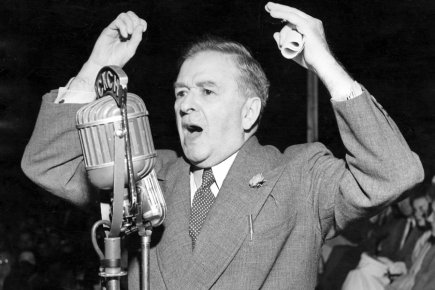 |
| A great dictatorial-like picture of Duplessis. |
In many ways, Duplessis reminds me of You-know-Who.
 |
| In case you had your head buried in the Sahara Desert in the last 15 years, yes, this is the evil Voldemort in Harry Potter. |
No, not that guy. This one:

- inappropriate direct financial support of Israel and their discrimination against charities supporting Palestine
- false pretenses of supporting "democracy" in the Middle East while they have deepened ties with Saudi Arabian monarchy, etc.
- dangerous deregulation of Canadian international mine companies, allowing them to operate with disastrous environmental and economic results in the countries of residence
- constant failing grades in matters of environmental sustainability such as pulling out of the Kyoto Protocol in 2011 and fighting to keep the Canadian tar sands off of California's list of "High Carbon emitters" (see B.1.)
There's something that I think we tend to forget as Canadians and Americans and that our European counterparts are much more apt at understanding: We live in a global community. I see the reason for this, notably the expanse of our national territory and so the (horizontally nautical) distance between us and our nearest neighbors. Also European countries have agreements via the European Union and the Council of Europe since after the second world war, which have worked greatly at lubricating country rapports and collaborations as well as cultural appropriations and market competition.
Why would any of us (and most of all, Stephen Harper) close our eyes to the wonderful strives going on elsewhere? Are we really that different? Do we really need to pollute and pillage the human and natural resources of other countries in order to be "economically sound" ourselves? If anything, that is the contrary of sustainability and long-term economic viability. Harper has shown us that he does not trust other countries, does not trust the medias and "does not trust" -and so has censored- canadian federal scientists, recently pushing the scientific community to announce the death of evidence on parliament hill. Not surprising in this case that he values the arts so little. Distrust is dangerous when in national and in international territory: In the first case you will alienate the people, and in the second, harvest enemies like the States has done in the middle east.
The last thing I want is another Great Darkness of any sort, be it in Quebec or in Canada at large. Let's get rid of the Harpie in 2015. After all, we too, as a country, deserve leaders with ideals like this. Listen to Uruguay's president Mujica speaking as a world citizen:
David Milne and European Cities
For the class of November 13th.
Ripon High Street is an urban planer's paradise: There are people, people, people in the streets! Street life is a great strength of many European cities in general, making them more liveable in general. As of lately, I have been reading Green Cities of Europe edited by Timothy Beatley. In the introduction, Beatly addresses Why European Cities? For one, he begins to answer, European cities are locally specific in their design. Perhaps most importantly, European cities have been a pioneer in terms of sustainable city design and strategy, collectively signing onto agreements such as the Aalborg Charter and entertaining friendly competition between cities for titles such as the European Green Capital.
North and South American Cities need to start not only thinking but acting this way. Let's be creative in the best sense of the word: imitating, modifying and combining the best of what other cities are doing to meet our particular region's needs. What Milne said about pictures, I can say about cities:
"I se one of my own (ideal North American cities), a little different from ones done before, changed slightly, very slightly, by (the European cities) I see before me."
Because it wouldn't be that hard, really.
Cheesy music aside (why do they always do that??), check out this video on Stockholm, the 2010 European Green Capital winner:
 | |
| Ripon High Street, watercolor over graphite on paper (1919) |
"I saw one of my own pictures, a little different from ones done before, changed slightly, very slightly, by what I saw before me."Milne was known for his modernist sketch-like paintings with great composition and lots of "bare" or "empty" space, like in the painting above where he draws attention to the negative space. Milne was a Canadian war artist as of 1917, and would have painted this painting while in England. There are many High Streets, but to my google-map knowledge only one Ripon in the United Kingdom (click link to view).
David Milne (1936)
Ripon High Street is an urban planer's paradise: There are people, people, people in the streets! Street life is a great strength of many European cities in general, making them more liveable in general. As of lately, I have been reading Green Cities of Europe edited by Timothy Beatley. In the introduction, Beatly addresses Why European Cities? For one, he begins to answer, European cities are locally specific in their design. Perhaps most importantly, European cities have been a pioneer in terms of sustainable city design and strategy, collectively signing onto agreements such as the Aalborg Charter and entertaining friendly competition between cities for titles such as the European Green Capital.
 |
| The cover fresh out of the printer's: 2012 Island Press |
"I se one of my own (ideal North American cities), a little different from ones done before, changed slightly, very slightly, by (the European cities) I see before me."
Because it wouldn't be that hard, really.
Cheesy music aside (why do they always do that??), check out this video on Stockholm, the 2010 European Green Capital winner:
mercredi 7 novembre 2012
Common Ground: Paraskeva, Eisler, Obama and Diaz
Tuesday we watched the Nation Film Board video Portrait of the Artist-As an Old Lady on Paraskeva Clark. For more information on the film itself and the NFB, click here.
Only 2.5 years to go under the Harper
government. Sigh.
Below, author Junot Diaz talks at the google complex about the nature of privilege and the role of the artist in relation. A must see for every artist and for every compassionate and logical human being!
 | |||||
| "Myself" a self-portrait by Clark |
The film, although informative and a great review of
Paraskeva's achievements, again made me think of the white anglo-saxon male
privilege. I just can't seem to get away from it, and probably never will.
That's okay. But I'll never accept it. Sure thee might be times when I'll brush
it aside in order to get a job or to help a community reach its goals, but
forget about it? Never.
I love addressing the uncomfortable and indeed, I can't help it. Sometime it is to a fault, alienating others without meaning to do so, and thus alienating myself. But most of the time, results are encouraging. As for Paraskeva, the privilege she shines into the light in one of class, nationality, and gender and her route, a politically-charged one.
Last night, Barack Obama was re-elected as president of the United States. Although I’m of the conviction that we as Canadians do not pay enough attention to our own politics or voice our political opinions enough, I also think that we should keep informed of what goes on in politics internationally. One does not contradict the other. And let’s face it, the U.S. is kind of a big deal.
I love addressing the uncomfortable and indeed, I can't help it. Sometime it is to a fault, alienating others without meaning to do so, and thus alienating myself. But most of the time, results are encouraging. As for Paraskeva, the privilege she shines into the light in one of class, nationality, and gender and her route, a politically-charged one.
Last night, Barack Obama was re-elected as president of the United States. Although I’m of the conviction that we as Canadians do not pay enough attention to our own politics or voice our political opinions enough, I also think that we should keep informed of what goes on in politics internationally. One does not contradict the other. And let’s face it, the U.S. is kind of a big deal.
So I watched the elections on campus amongst fellow students
who are citizens, like me, of a now global community. I think it is no
understatement to say that the whole world was watching. A lot was riding on
the outcome of this election, be it economically, in terms of human rights, and
in terms of war and peace. From my point of view, peace won, gender equality
made great strides, green energy got rooted and, making Paraskeva proud,
socialist ideas in healthcare won.
I am immensely proud of our neighbor's electoral decision. Now if we could only do the same here; if we could only focus, once again, on the people of our nation. Yes, the economy is important. But why? Sure it is important to feed people, to buy education, to afford a shelter above everyone's dream-filled heads. But what makes us happy are the people people in our lives and the realationships (sic) we forge with them. However, the "public sphere" -professional and institutional- is the one given the most importance by conservatives in Canada by the Republicans in the United States. Yet The Real Wealth of Nations, according to Riane Eisler, is found within the two layers that ground the institutional and professional levels: volunteer-based economy and domestic or private economy. Without these, the two top spheres could not function. Yet these are severely undervalued, consisting of the historically oppressed: women, children, the elderly, visible minorities, the middle-lower and lower class. And yet tremendous energy is generated and stocked here, rich by the very relationships that make us human and motivated by the hopes and dreams that we cannot help but grow.
I am immensely proud of our neighbor's electoral decision. Now if we could only do the same here; if we could only focus, once again, on the people of our nation. Yes, the economy is important. But why? Sure it is important to feed people, to buy education, to afford a shelter above everyone's dream-filled heads. But what makes us happy are the people people in our lives and the realationships (sic) we forge with them. However, the "public sphere" -professional and institutional- is the one given the most importance by conservatives in Canada by the Republicans in the United States. Yet The Real Wealth of Nations, according to Riane Eisler, is found within the two layers that ground the institutional and professional levels: volunteer-based economy and domestic or private economy. Without these, the two top spheres could not function. Yet these are severely undervalued, consisting of the historically oppressed: women, children, the elderly, visible minorities, the middle-lower and lower class. And yet tremendous energy is generated and stocked here, rich by the very relationships that make us human and motivated by the hopes and dreams that we cannot help but grow.
 |
| The cover of Riane Eisler's book, playing off of the outdated and similarly titled "The Wealth of Nations" by Adam Smith. |
The
election of president Obama as leader of the United States gives me hope in the
same way as art gives me hope for a better tomorrow. In my opinion, he is
someone who understands the oppressiveness of privilege and its predatory nature,
but most importantly is someone who has worked hard and earned what he has,
despite adversity in the form of economic and ethnic disadvantage.
Below, author Junot Diaz talks at the google complex about the nature of privilege and the role of the artist in relation. A must see for every artist and for every compassionate and logical human being!
dimanche 4 novembre 2012
Creatives For The People
Last class we touched on art between the wars, in America called Social Realism. The movement honored the working class a time dominated by the Great Depression by union workplace reforms. Notable artists were Raphael Soyer, Miller Brittain (from Saint John, NB), Jack Humphrey, and Paraskeva Clark.
In the same way that these artists were making art work about the people for the people of the time, I find current architects and urban planners thinking more and more about people, and I love it! Here one of my new found favorites, Jan Gehl, resumes his view on how architecture and infrastructure should work. The man is the author of Cities For People, and waves around a mean water bottle. Interested in what he says? Check out one of the many youtube videos of his presentations.
 | |
| "Petrushka" by Paraskeva Clark (1937) |
Carr and The Fauves
Okay. So we are not done. Not yet. So let me diverge on slightly Emily Carr-related subjects once more.
A defining moment in Carr's life was reached while in France for a total of 14 months. There, she encountered the works of Matisse, a Fauve movement artist. A few years ago, I got to see works by the fauves at the Musée des Beaux-Arts de Montréal. I liked how daring it must have been to use such bold colors at the time, and the results themselves were gorgeous.
Personally, I see the influence of such works on my own colour choices as an artist who occasionally paints. For example this portrait of my cousin Jessica (on a side table) features her in a Fauve-like palette.
As for Emily Carr, you can clearly see the influence of the Fauves in paintings such as "Autumn Trees".
Although not a traditional exemple since it was produced later in Carr's life, I find the painting "Sky" (below) to also be fairly Fauvist, although maybe more Impressionist or reminescent of Vincent Van Gogh.
This all goes, again, to prove that artists live in all but an ivory tower. Oh the permeability of ideas!
A defining moment in Carr's life was reached while in France for a total of 14 months. There, she encountered the works of Matisse, a Fauve movement artist. A few years ago, I got to see works by the fauves at the Musée des Beaux-Arts de Montréal. I liked how daring it must have been to use such bold colors at the time, and the results themselves were gorgeous.
 |
| "Portrait of a Cabaret Singer" by Fauve artist Kees van Dongen |
 |
| In 2009 in front of the Musée, dorky art-geek smile and all! |
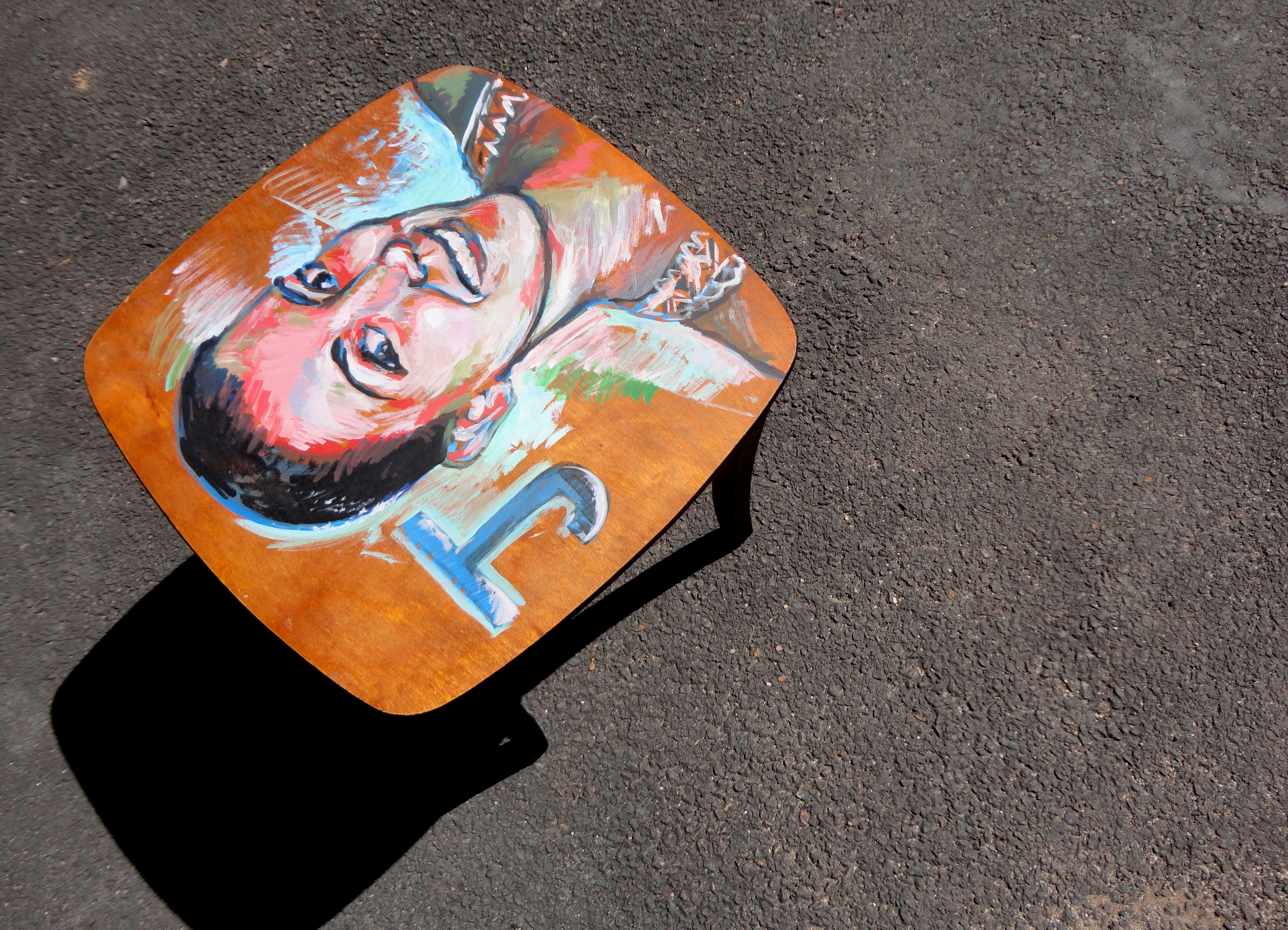 |
| Claire Gallant, "Jessica" (2012) |
 |
| "Autumn Trees" by Emily Carr |
 |
| "Sky" Emily Carr (1935-36) |
mardi 30 octobre 2012
Colonizer Privilege and The Myths of Creativity
Today we had a slightly saturated class. We didn't really know where to start, actually. Or rather, we didn't really want to. What was there left to say about Emily Carr, after last week's presentations, the loaded discussions that ensued and the four readings for this week? One thing is certain: To all of us now, Emily Carr and her work are multi-dimentional entities.
I'd like to wrap things up with Carr and her work, to summarize what I've learnt alongside contemporary and historical analysis of her phenomenon. Mostly I think that Carr herself was soaked in colonial thought, perhaps most importantly in the discourse that "Indians" were a dying people, instead of a culture in which a lot of people were dying. This approach should come as no surprise however, given the clearly articulated intentions of British government officials to make Natives "disappear". This should, put into modern daylight, serve in no way to justify racist implications by Carr. These are history lessons, but it is while evaluating tough topics like these that we tie the past into a broader picture. Why re-evaluate past icons under a contemporary light? Why criticize today what people yesteryear had no way of understanding? The answer lies in the future. We are re-evaluating them because they have been woven into our euro-centric popular culture's fabric, and in so being are a part of our individual fabric without us even knowing. I became incredibly frustrated with the setting. While criticizing the dominance of white British colonizers, here we were, in great majority white anglo-saxons (if not in totality), sitting comfortably at Mount Allison University, which upholds the most expensive undergraduate tuition in Canada. Despite student debts, most of us are middle to upper-middle class. A university degree will open administrative and socio-economic doors for us. And we are discussing Native issues in the absence of people who define themselves as Aboriginal.
Many things have happened, but not that much has changed. This makes me uncomfortable.
But I am glad. I am glad to have been given this opportunity. I am glad to have been shown things in my own cultural fabric that are not pretty. I just wish we were hearing the Aboriginal's take on all of this. Why not? Is there something uncivilized in the way they say it? Is it not academic enough, not annotated enough? What are the hoops that aren't getting jumped through? What is going on today and where do they want to be tomorrow?
Nothing in this issue is simple, and in my mid-term crunch, this issue is a doozy. But I have been finding time and effort to discuss it, to address it with friends in order to hear opinions. Honestly, to not do so for me would probably take even more effort!
Saturday four of us went to Amherst, stopping at a Mom and Pop restaurant for dinner. Miriam, of African descent, has been studying the decolonization of African countries. All of us were interested in the appropriation and sharing of ideas, of information, of images. Open-access, patents. Apparently, 97% of the human body's chemical compounds are now patented for creation in the lab. In agriculture, crop seeds are biologically engineered and sold to live for one season only, obligating farmers to buy again, maximizing profits and enforcing market monopoly. The issue of Native image appropriation by modern-day and Carr-day colonizers, in many ways, is not so much an issue or a problem in itself. To steal, modify, and re-combine elements is natural, human, healthy and indeed the only way creativity works. The isolated, uninfluenced genius with his flash of lightening "aha!" moment is a myth. Artists and creators of all types brew, meddle, borrow. The problem, as it is, is that one group is still oppressed and that another is still oppressing. In a playground, if an older kid asks you nicely for your lunch while waving around a heavy club, you give him your lunch. In many ways, that still seems to be the situation today, that club being privilege (including institution) and the sandwich being native culture (including imagery). When two socially and economically equal parties exchange information, there is no issue. Unless you're Steve Jobs.
I'd like to wrap things up with Carr and her work, to summarize what I've learnt alongside contemporary and historical analysis of her phenomenon. Mostly I think that Carr herself was soaked in colonial thought, perhaps most importantly in the discourse that "Indians" were a dying people, instead of a culture in which a lot of people were dying. This approach should come as no surprise however, given the clearly articulated intentions of British government officials to make Natives "disappear". This should, put into modern daylight, serve in no way to justify racist implications by Carr. These are history lessons, but it is while evaluating tough topics like these that we tie the past into a broader picture. Why re-evaluate past icons under a contemporary light? Why criticize today what people yesteryear had no way of understanding? The answer lies in the future. We are re-evaluating them because they have been woven into our euro-centric popular culture's fabric, and in so being are a part of our individual fabric without us even knowing. I became incredibly frustrated with the setting. While criticizing the dominance of white British colonizers, here we were, in great majority white anglo-saxons (if not in totality), sitting comfortably at Mount Allison University, which upholds the most expensive undergraduate tuition in Canada. Despite student debts, most of us are middle to upper-middle class. A university degree will open administrative and socio-economic doors for us. And we are discussing Native issues in the absence of people who define themselves as Aboriginal.
Many things have happened, but not that much has changed. This makes me uncomfortable.
But I am glad. I am glad to have been given this opportunity. I am glad to have been shown things in my own cultural fabric that are not pretty. I just wish we were hearing the Aboriginal's take on all of this. Why not? Is there something uncivilized in the way they say it? Is it not academic enough, not annotated enough? What are the hoops that aren't getting jumped through? What is going on today and where do they want to be tomorrow?
Nothing in this issue is simple, and in my mid-term crunch, this issue is a doozy. But I have been finding time and effort to discuss it, to address it with friends in order to hear opinions. Honestly, to not do so for me would probably take even more effort!
Saturday four of us went to Amherst, stopping at a Mom and Pop restaurant for dinner. Miriam, of African descent, has been studying the decolonization of African countries. All of us were interested in the appropriation and sharing of ideas, of information, of images. Open-access, patents. Apparently, 97% of the human body's chemical compounds are now patented for creation in the lab. In agriculture, crop seeds are biologically engineered and sold to live for one season only, obligating farmers to buy again, maximizing profits and enforcing market monopoly. The issue of Native image appropriation by modern-day and Carr-day colonizers, in many ways, is not so much an issue or a problem in itself. To steal, modify, and re-combine elements is natural, human, healthy and indeed the only way creativity works. The isolated, uninfluenced genius with his flash of lightening "aha!" moment is a myth. Artists and creators of all types brew, meddle, borrow. The problem, as it is, is that one group is still oppressed and that another is still oppressing. In a playground, if an older kid asks you nicely for your lunch while waving around a heavy club, you give him your lunch. In many ways, that still seems to be the situation today, that club being privilege (including institution) and the sandwich being native culture (including imagery). When two socially and economically equal parties exchange information, there is no issue. Unless you're Steve Jobs.
Watch "Everything Is A Remix"on Vimeo, previewed above in Ferguson's TedTalk,
a fantastic four-part documentary on creativity as copying, combining, and transforming.
Inscription à :
Articles (Atom)